
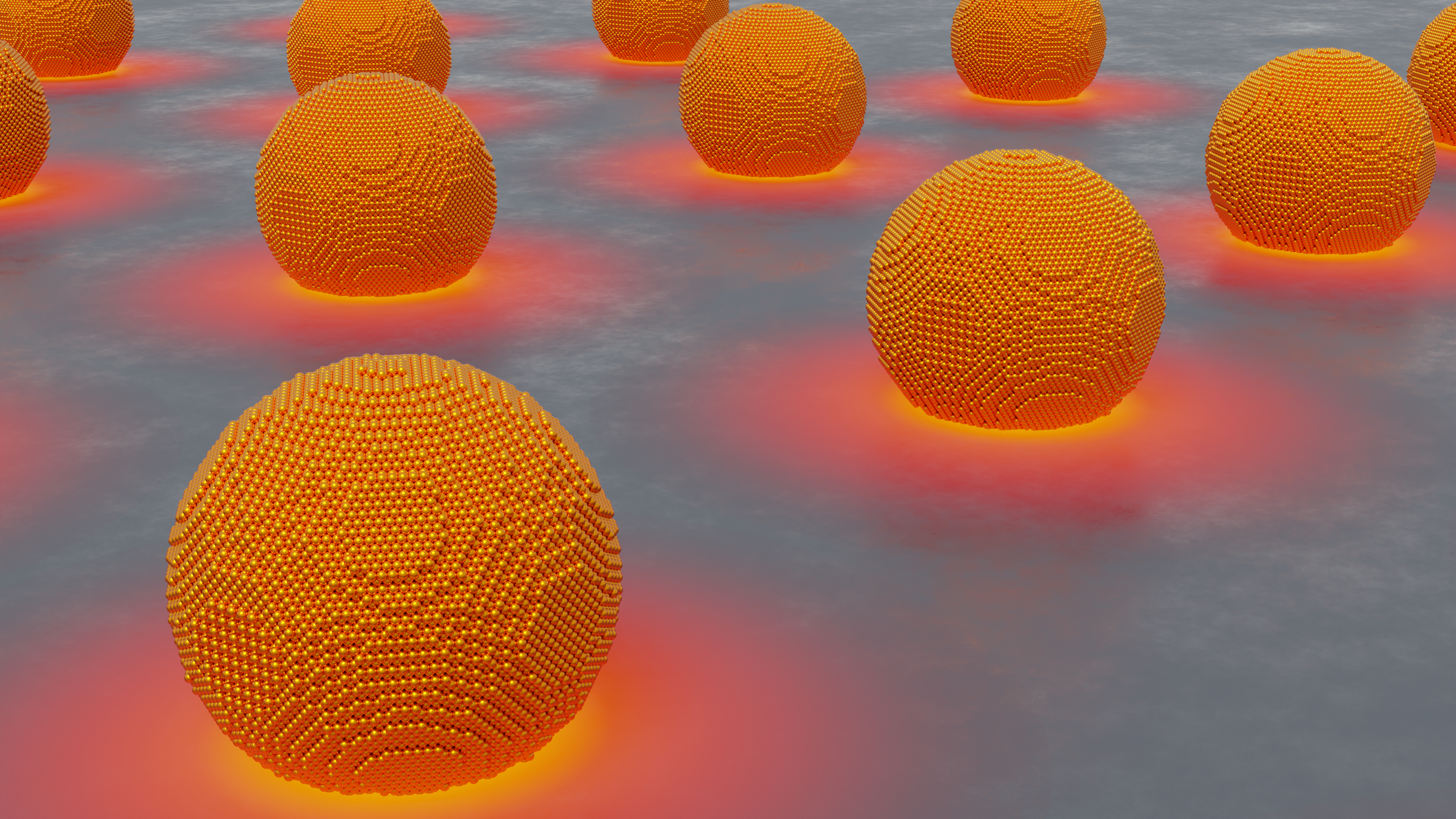
Our lab at Vrije Universiteit Amsterdam studies light-controlled heat flow at nanoscale dimensions and on (ultra)fast timescales. We apply our ideas to designing materials for a circular society, driving chemical reactions in a more sustainable manner, and recycling waste streams into valuable building blocks.
Jump directly to

Pulsed photothermal catalysis: improving chemical conversion through ultrafast heating
One of the biggest challenges in catalysis is to deliver thermal energy to the reaction sites efficiently, without unnecessary heat loss. Conventional catalytic reactors rely on steady-state heating, which often leads to inefficient energy use, catalyst degradation, and suboptimal reaction rates.
In our lab, we move away from steady-state operation with pulsed photothermal catalysis. Here, laser pulses generate rapid and highly localized temperature spikes on the catalyst surface. Using plasmonic nanomaterials as light absorbers and pulsed lasers to excite them, we can tune the intensity, duration, and repetition rate of the heat pulses to optimize different catalytic reactions.
This approach has several advantages. First, the pulses drive chemical reactions at very high rates. Our simulations show that reaction rates at least 100× faster than under steady-state conditions are possible. Second, it reduces energy consumption. Instead of heating the entire reactor, we only apply heat where it is needed.
Crucially, the chemistry takes place under non-steady-state conditions, where the energy available on the catalyst surface changes continuously. Our research indicates that by choosing a pulse “rhythm” that matches the underlying transport phenomena and catalytic cycles, we can control the distribution of adsorbed species at the moment the next pulse arrives. This can be used to enhance the selectivity of catalytic reactions and to manipulate reaction pathways, which we are now exploring in experiments.
Finally, heat pulsing can improve catalyst lifetime. Because the catalyst is heated only transiently, and not kept at a high temperature continuously, slow degradation processes such as sintering and migration are suppressed. We therefore study how intense heat pulses affect long-term stability.
Nanoscale thermometry and heat localization: precision temperature mapping for catalysis
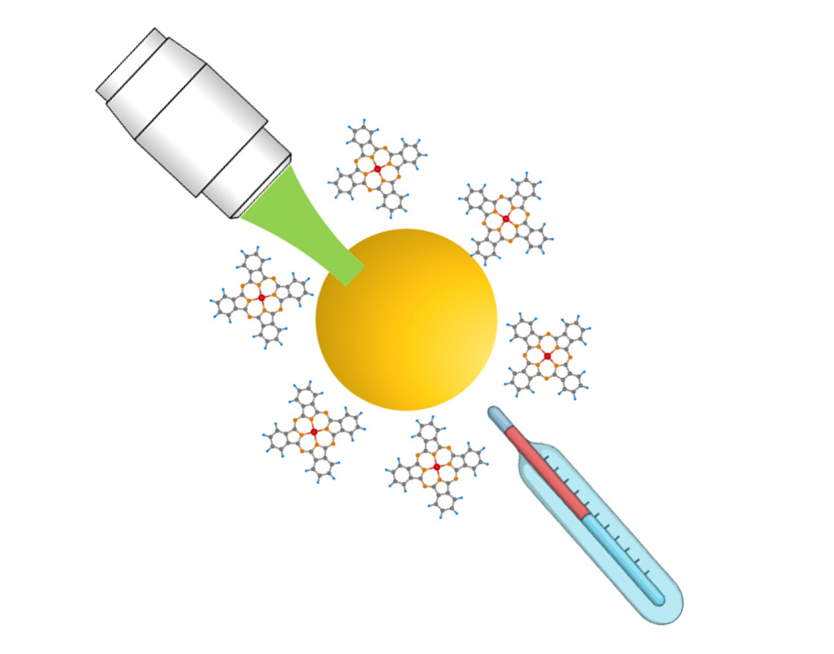
Accurately measuring and controlling local temperatures at the nanoscale is crucial in a broad range of technologies, such as heat management in computer chips and quantum computers, and the optimization of catalyst nanomaterials. However, conventional methods such as thermocouples or infrared thermometry lack the spatial resolution to detect nanoscale temperature variations.
Together with the groups of Andrea Baldi and Charusheela Ramanan, we develop nanoscale thermometry based on Raman spectroscopy, using copper phthalocyanine (CuPc) thin films as temperature-sensitive probes. This technique allows us to quantify localized temperature changes down to the nanometer scale.
With CuPc we have developed a robust thermometer that reliably reports the local temperature up to 300 °C. We are now applying this technique to single-nanoparticle studies and beyond.

Breaking the limit of nanoscale optical heating
A frontier in photothermal catalysis is the ability to generate and control heat below the scale of a single nanoparticle. Such “thermal hotspots”, where heat is strongly confined in space, would give control over reaction dynamics and could drive chemical transformations with minimal energy input. We are working on a new way to generate thermal hotspots that can exist for hundreds of picoseconds under pulsed illumination. These “ultrafast thermal hotspots” give access to extreme local temperatures with only mild illumination.
Normally, the high thermal conductivity of metal nanoparticles prevents large internal temperature gradients. We therefore use unconventional materials that are better suited for this approach. We design and fabricate plasmonic metal nitride nanostructures (HfN, TiN) as robust light-to-heat converters that convert light energy fully into heat within 100 fs.
Our research has shown that these structures give precise temporal and spatial control of heat deposition, and 3× higher temperatures than their gold analogues. Next, we will apply them to catalytic conversion. By controlling the intensity, frequency, and duration of the light pulses, we aim to tune heat transfer at the nanometer level, for light-driven chemical synthesis, catalysis, and materials transformations.
Metal nitride plasmonics: high-temperature and ultrafast catalysis with robust materials
Conventional plasmonic materials such as gold (Au) and silver (Ag) are widely used in photothermal applications because they absorb light strongly. However, they are thermally unstable. At high temperatures they melt, deform, and lose their function.
To overcome these limitations, we investigate transition metal nitrides such as hafnium nitride (HfN) and titanium nitride (TiN) as alternative plasmonic materials for high-temperature applications. These materials offer exceptional thermal stability (they withstand temperatures above 1000 °C without degradation), broad optical absorption across visible and infrared wavelengths, and chemical robustness against oxidation and corrosion.
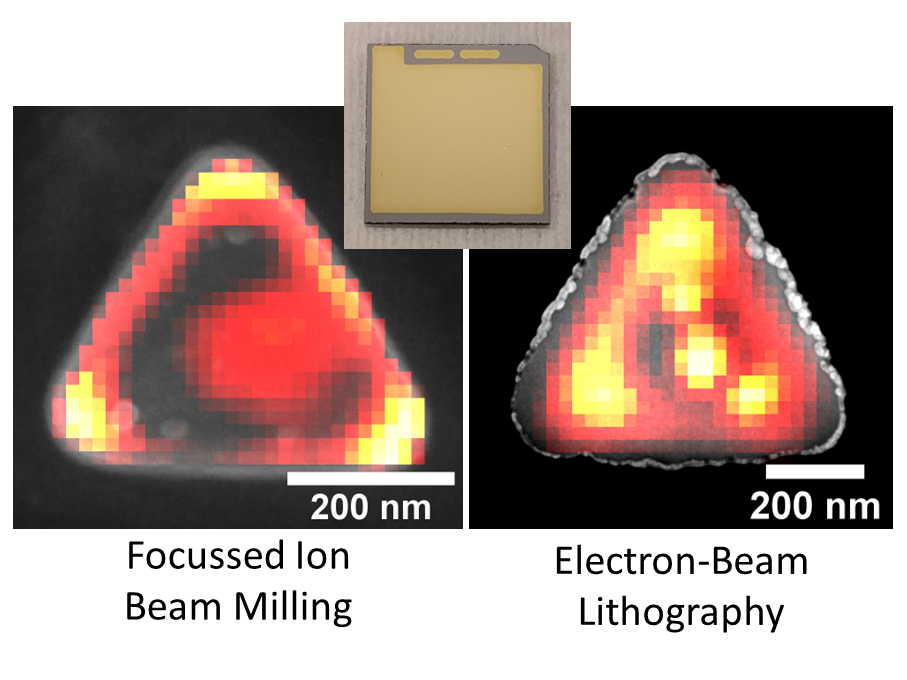
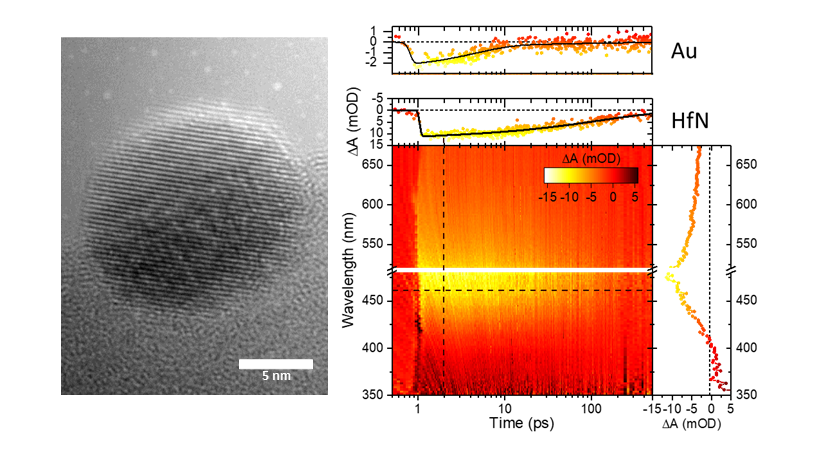
We have fabricated HfN nanostructures with focused ion beam milling and electron-beam lithography, and mapped their plasmonic modes with cathodoluminescence. We have also synthesized colloidal HfN nanocrystals and studied their photophysical dynamics with transient absorption spectroscopy, combined with optical and heat-transfer finite-element modelling in COMSOL. We found that these nanocrystals convert all absorbed light energy into heat within 100 fs, due to very strong electron-phonon interactions in this material.

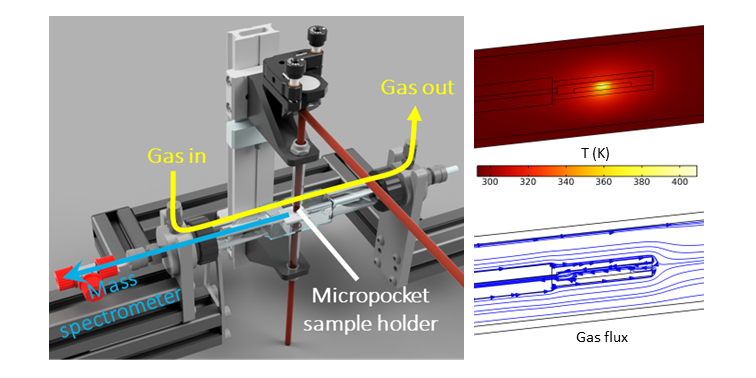
Simulating photothermal reactors and mapping thermal gradients to understand light-driven chemistry
In photothermal catalysis, understanding how light interacts with catalysts to generate heat is crucial for optimizing reaction efficiency. In light-driven reactions the temperature is rarely uniform, which can lead to large experimental errors. Experiments provide crucial insights, but simulations are just as valuable, because they predict temperature distributions, reaction kinetics, and energy transfer with high precision.
In our lab, we develop multiscale simulation models that combine
- electromagnetic modelling (Lumerical FDTD, COMSOL) of light absorption and heat generation in plasmonic nanostructures,
- heat-transfer simulations (COMSOL) of how heat propagates and dissipates at the nanoscale,
- microkinetic modelling of how temperature fluctuations influence reaction rates and selectivity, and
- heat and fluid dynamics on the macroscale (COMSOL) to design lab-scale photothermal reactors and simulate the whole system under illumination.
Why our research matters
Our work on photothermal catalysis, nanoscale thermometry, and new materials improves our fundamental understanding of nanoscale heat management, catalysis, and sustainable chemistry. It contributes to
- more energy-efficient chemical reactors that use light instead of fossil fuels for heating,
- more selective catalytic reactions with fewer unwanted byproducts, and
- new nanomaterials that are stable under extreme conditions, expanding the possibilities of photothermal applications.
Want to collaborate on any of these topics?